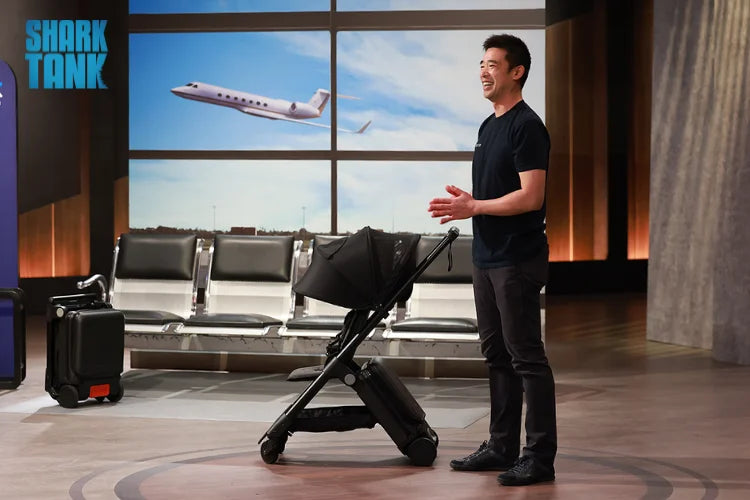
Yes, you can bring a stroller on a plane. On most major airlines it's completely free, and it doesn't count toward your standard baggage allowance. You have three options: gate check it at the aircraft door, check it at the ticket counter, or bring a compact stroller into the overhead bin as your carry-on item.
Which option works best depends on your stroller's size and your airline's specific rules. This guide covers all three, what TSA expects at security, how to protect your stroller from damage, and answers to the questions parents most often get wrong before they reach the airport.
Can You Take a Stroller on a Plane?
Yes. Most major airlines, including Delta, United, Southwest, American, Alaska, JetBlue, British Airways, Qantas, Emirates, and Air New Zealand, allow you to travel with a stroller at no extra charge. On these airlines, a stroller is treated as a child-use item with its own separate policy, not as part of your standard carry-on or checked baggage allowance.
Budget and low-cost carriers (Spirit, Frontier, Ryanair, easyJet) also allow strollers but their policies vary more and enforcement of size rules tends to be stricter. Always check your specific airline before you fly.
The key point: A stroller does not take the place of your carry-on bag. It is an additional item, unless you choose to bring it into the cabin overhead bin, in which case it does count as your carry-on.
Is it Free to Fly with a Stroller?
In almost all cases, yes. Here's how the major airlines handle it:
|
Airline |
Free stroller? |
Where checked |
|
|
Delta |
Yes — free |
Curb, counter, or gate |
|
|
United |
Yes — free |
Counter or gate |
|
|
Southwest |
Yes — free |
Curb, counter, or gate |
|
|
American |
Yes — free |
Counter or gate |
|
|
British Airways |
Yes — free |
Counter or gate |
|
|
Emirates |
Yes — free |
Gate only (one item) |
|
|
Qantas |
Yes — free |
Counter or gate |
|
|
Virgin Australia |
Yes — free |
Counter or gate |
|
|
Air New Zealand |
Yes — free (jet routes) |
Counter or gate |
|
|
Jetstar |
Yes — free |
Counter only (no gate check) |
Your Three Options for Flying with a Stroller
Option 1: Gate checking (most popular)
Gate checking is what most parents do, and for good reason. You use your stroller through the entire airport, check-in, security, terminal, and all the way to the aircraft door. Just before boarding, you fold it, hand it to the gate agent, and it's loaded into the cargo hold.
On arrival, the stroller is returned to you at the jet bridge (aircraft door) on most airlines, you don't need to go to baggage claim. This is the same exit point where you walk off the plane, so you have your stroller almost immediately.
What to do: Get a gate-check tag from the agent when you first arrive at the gate, not at the last minute when everyone is boarding. This ensures the tag is properly filled out with your destination and the stroller is returned to the right place.
The downsides of gate checking: You hand over the stroller before boarding, which means carrying your child through the boarding area and down the jet bridge without it. On arrival, there's sometimes a wait at the jet bridge while the stroller is retrieved from the hold, on busy flights this can take 10–20 minutes.
Option 2: Checking at the ticket counter
You can check your stroller at the curb or ticket counter when you first arrive at the airport, just like regular luggage. This is free on most airlines and doesn't affect your baggage allowance.
The trade-off: your stroller goes to baggage claim rather than the jet bridge. You'll need to navigate the entire airport, security, and the terminal without it, which means carrying or holding your child the whole time.
This option makes sense if you have a baby carrier you're comfortable using through the airport, or if your stroller is large and you don't want to manage it at the gate.
Option 3: Bringing it into the cabin overhead bin
If your stroller collapses within airline carry-on dimensions, typically 56 × 36 × 23cm (22" × 14" × 9"), it can go in the overhead bin. This means it stays with you throughout the flight, is available immediately on landing, and faces no risk of hold-baggage handling damage.
The catch: in the cabin, the stroller counts as your carry-on item. You can still bring a personal item under the seat in front of you, but you won't also have a full-size overhead bag.
Which strollers actually fit? Standard and umbrella strollers generally don't collapse small enough. Compact travel strollers designed specifically for cabin storage, like the GB Pockit, TernX Carry-On Luggage Stroller, or YOYO by Stokke — are built to meet these dimensions.
What Size Stroller Fits in the Overhead Bin?
The IATA recommended maximum for overhead bin items is 56 × 45 × 25cm, but individual airlines set their own limits. Most use 56 × 36 × 23cm (22" × 14" × 9") as the standard. Your stroller must fit folded, including wheels, handles, and any protruding parts.
|
Airline |
Overhead bin max dimensions |
|
Delta |
56 × 35 × 23cm (22" × 14" × 9") |
|
United |
56 × 35.5 × 23cm (22" × 14" × 9") |
|
Southwest |
25 × 40 × 61cm (10" × 16" × 24") |
|
British Airways |
56 × 45 × 25cm (22" × 18" × 10") |
|
Qantas |
56 × 36 × 23cm |
|
Virgin Australia |
56 × 36 × 23cm |
|
Air New Zealand |
55 × 40 × 23cm |
|
Jetstar |
56 × 36 × 23cm |
|
Emirates |
55 × 38 × 20cm (7kg limit — 20cm depth is very tight) |
British Airways has the most generous dimensions (especially in width at 45cm), making it more accommodating for travel strollers. Emirates has the strictest depth limit at 20cm, very few strollers meet this.
The TernX Carry-On Luggage Stroller folds to 55 × 36 × 23cm, within the overhead bin limits of most major airlines and includes 18L of built-in luggage space, eliminating the need for a separate carry-on bag. It is certified to EN1888, ASTM, and AS/NZ standards as a stroller, and IATA-compliant as carry-on luggage.
→ See the TernX Carry-On Luggage Stroller
Read here for more information on strollers that fit in the overhead compartment.
Going Through TSA Security with a Stroller
Security with a stroller is manageable once you know what to expect. Here are the TSA rules, verified from the official TSA website:
-
Remove your child from the stroller before going through the metal detector. Carry them in your arms through the walk-through metal detector. Infants may be carried in a sling or carrier.
-
The stroller must go through the X-ray machine. Fold it and place it on the belt. Compact strollers typically pass through the machine without issue. Larger strollers may not fit and will be visually/physically inspected by TSA officers instead. This is normal and not a problem.
-
Remove items in the stroller before putting the stroller through screening.
-
If you have TSA PreCheck, children 17 and under can use the PreCheck lane with you at no additional cost.
-
TSA has 'Families on the Fly' dedicated lanes at select airports. Look for them to reduce congestion.
Can You Take a Full-Size or Double Stroller on a Plane?
Full-size strollers
Yes, you can travel with a full-size stroller. It cannot be gate-checked on most airlines because it won't fold down compactly enough for gate handling. It needs to be checked at the ticket counter, where it will be handled as oversized baggage and collected at baggage claim.
Full-size strollers are more susceptible to damage in the hold. A padded stroller travel bag significantly reduces the risk.
Double strollers
Double strollers are permitted on most airlines but must be checked in at the ticket counter, not gate-checked. They will always be too large for the overhead bin. Budget for extra time at check-in and plan to carry both children through the terminal.
Some airlines count a double stroller as a single item free of charge; others may apply oversized baggage rules. Check your specific airline's policy before you fly.
What Happens to Your Stroller When it's Gate-Checked?
Once you hand it over at the aircraft door, your stroller is tagged and loaded into the cargo hold with other luggage. It does not travel in a protected area, it's handled by baggage staff and stacked with other items.
On arrival, it's brought back up to the jet bridge on most airlines. On some international routes, or if the flight was very full, it may end up at the oversized baggage carousel instead. Ask the gate agent when you check it in whether it will be returned jet-side or at baggage claim.
How to Protect Your Stroller When Flying
Gate-checked and counter-checked strollers are handled by baggage staff and can take damage, especially if they don't have protective covering. Here's how to reduce that risk:
-
Use a stroller travel bag. A padded travel bag protects against scratches, dents, and dirt. It also makes the stroller easy to identify on the baggage carousel. Bright colours help.
-
Label it clearly. Attach a luggage tag with your name, phone number, and destination to both the stroller and the travel bag. Strollers are one of the last items to appear at baggage claim and can get mixed up.
-
Remove accessories before handing it over. Detach cup holders, snack trays, sun canopies, and anything else that protrudes. These are the parts most likely to snap off in the hold.
-
Inspect on arrival before leaving the jet bridge. If your stroller is damaged, report it to the airline's baggage service desk at the airport before you leave. Claims filed after you leave are harder to process.
-
Consider bringing it overhead instead. A carry-on sized stroller that travels in the overhead bin faces none of these risks. It stays with you throughout the flight.
Airline-Specific Stroller Policies
Every airline has slightly different rules. We've written detailed guides for the most popular routes:
British Airways Stroller Policy